
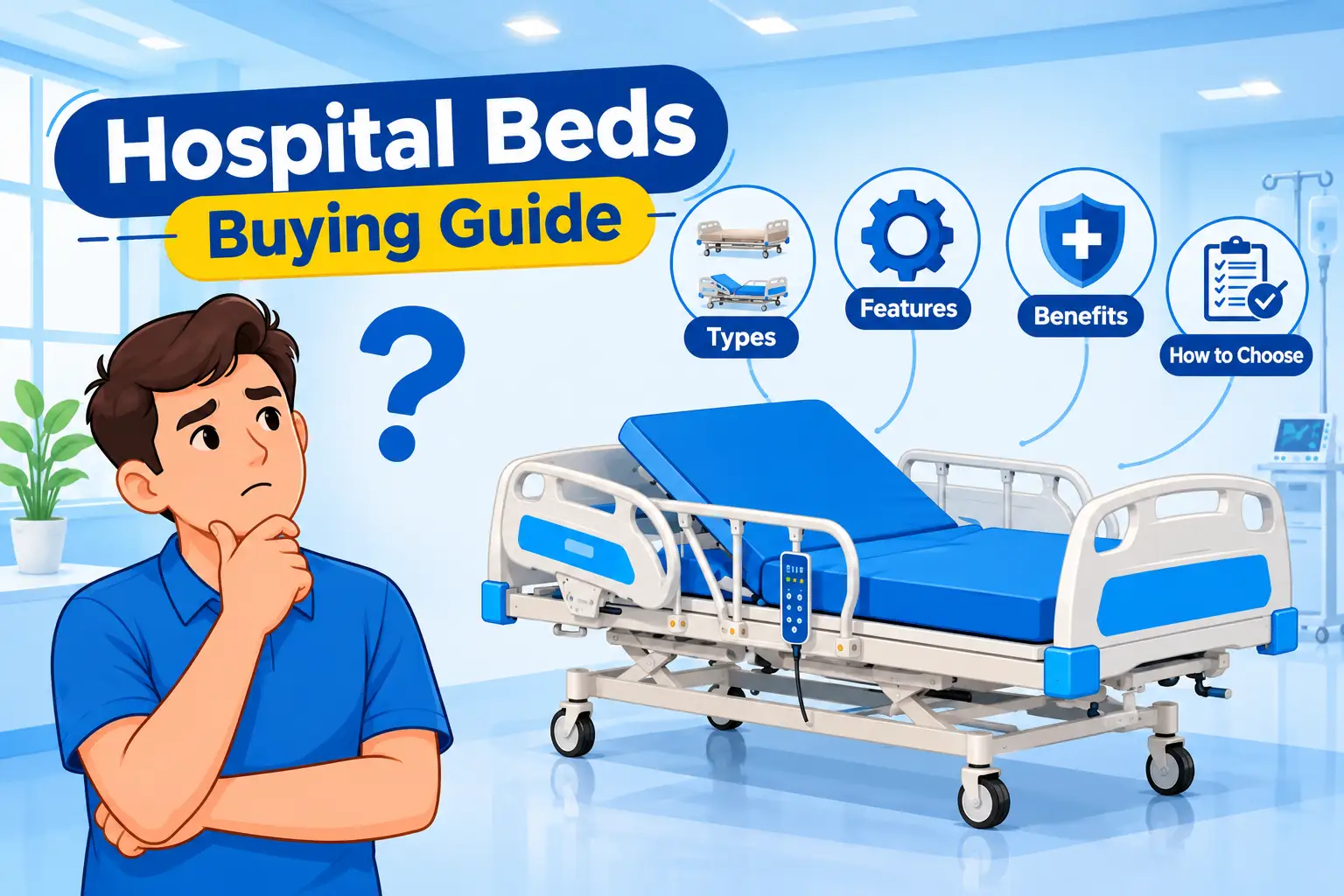
Hospital Beds: Complete Buying Guide – Types, Features, Benefits & How to Choose the Right One
Hospital beds are workhorses in the world of healthcare. The right hospital bed helps prevent injuries to patients from falls and pressure sores. It also aids in the acceleration of the patient’s healing process by changing the patient’s position regularly. The wrong bed increases financial burden and wastes space. It also puts the patient at risk.
This all inclusive hospital bed buying guide breaks down types of hospital beds, explains models (manual, semi-electric, and fully electric), important features, what factors effect price, and gives an easy way to choose the right bed. The info provided in this guide works for any bed-related purchase whether it is for a home, nursing home, or hospital.
What Types of Hospital Beds Are Available for Home Use?
Not all hospital beds are built for the same job. Match the bed to the patient’s condition, care setting and level of mobility.
- Manual hospital beds: Cheaper and more reliable option for low usage or budget conscious settings.
- Semi-electric hospital beds: The foot and head sections are powered, while the height is adjusted manually.
- Fully electric hospital beds: All sections are powered and adjusted with the touch of a button.
- ICU and critical care beds: Includes scales, CPR release, and X-ray sections. These beds offer tilting functions as well.
- Bariatric hospital beds: Designed to support heavier patients and have higher weight capacities.
- Low hospital beds (floor-level beds): Reduce injuries from falls because of low height to the ground.
- Pediatric hospital beds: Smaller designs with high side rails.
- Birthing and maternity beds: One-unit solution for labor, delivery and post-partum recovery.
- Alternating pressure and air-mattress beds: Help in the prevention and treatment of pressure ulcers.
- Stretcher and trolley beds: Used in transport of patient. Also found in Emergency Departments.
Manual vs. Semi-Electric vs. Fully Electric Hospital Beds
Fully electric hospital beds suit most long-term care, while manual beds win on price and semi-electric beds balance the two. The key difference is how much effort each adjustment takes and who does it.
| Feature | Manual | Semi-electric | Fully electric |
|---|---|---|---|
| Head and foot adjustment | Hand crank | Motorized | Motorized |
| Height adjustment | Hand crank | Hand crank | Motorized |
| Patient can self-adjust | No | Partly | Yes |
| Caregiver effort | High | Medium | Low |
| Needs power | No | Yes | Yes |
| Works in power cuts | Yes | Limited | Battery backup models only |
| Relative cost | Lowest | Mid | Highest |
| Best for | Short-term, budget, backup | Home care, moderate use | Daily care, hospitals, independence |
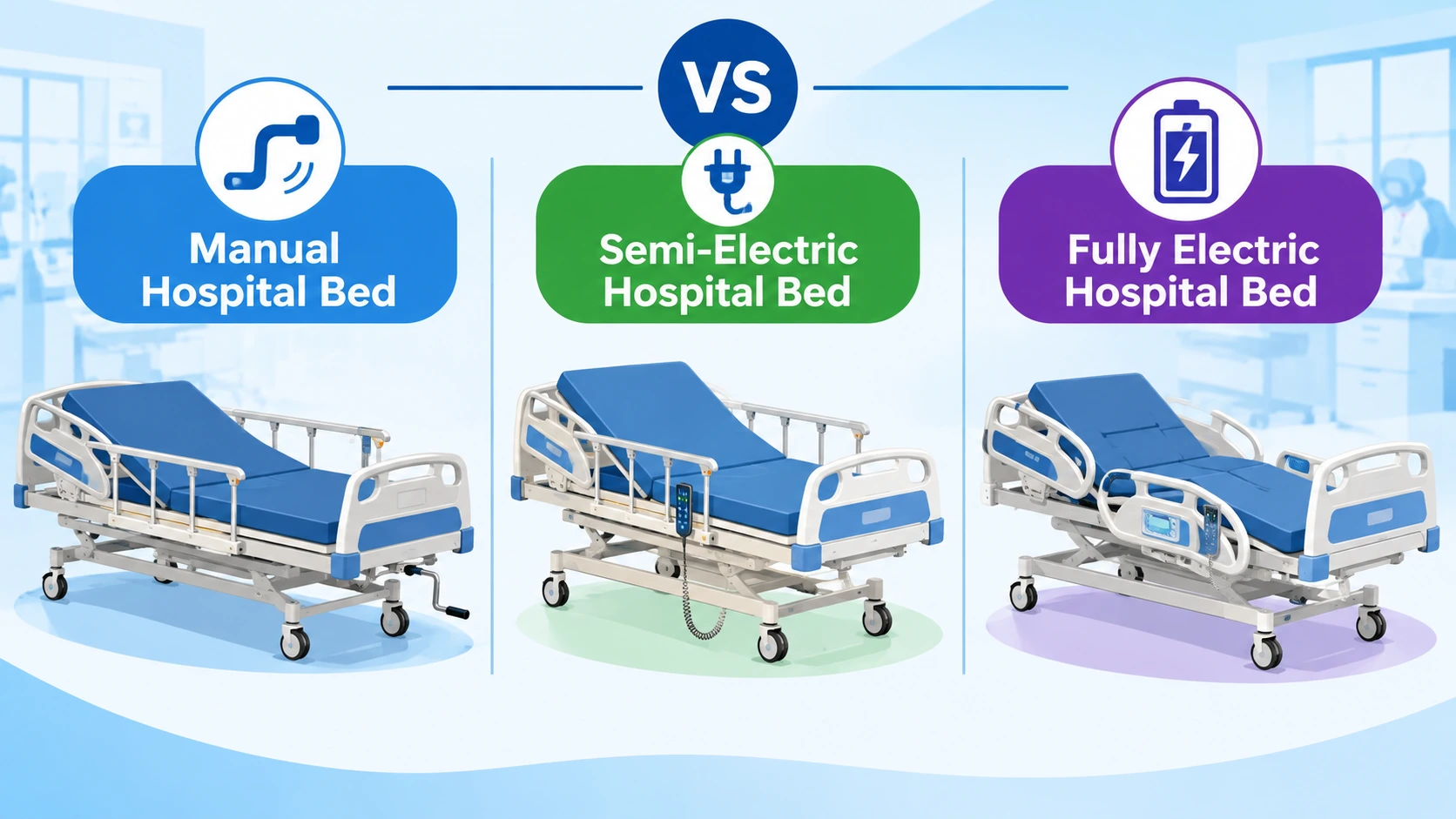
Choose a manual bed if the cost is primary concern or if the bed will be rarely in use. Choose semi-electric bed if the cost and effort are primary concerns. Go for a fully electric bed if the patient is in bed most of the day and needs to be frequently re positioned. It is beneficial to the caregivers as the bed can be adjusted to the best position for care.
Important Features and Accessories to Look For
The best hospital beds combine safety, comfort and ease of use. Check these before you buy.
Core features
- Adjustable positions: Beds should be able to be raised to a position which helps in provision of care to patient. Furthermore, bed height should be adjustable to promote an upright seating position for the patient and help in prevention of bedsores.
- Weight capacity: Look for a bed which has weight capacity greater than what is expected to be used.
- Side rails: Half rails should be used for support when turning and are to be used as advised by care team.
- Strong, quiet motors: Nice quiet motors are a must in a home setting.
- Locking castors: Centralized brakes hold the bed in position, while allowing it to be moved for easy cleaning.
- Easy-clean surfaces: Antimicrobial surfaces, sealed surfaces, and washable surfaces prevent the spread of infections.
- Battery backup: Allows the bed to be adjusted during power outages.
- CPR release: Allows the bed to be lowered quickly to a flat position.
Useful accessories
- Pressure-relieving mattress (foam, alternating air or gel)
- Overbed table and bedside locker
- IV pole and drainage bag holder
- Trapeze or grab handle to help patients reposition
- Bed alarm or exit sensor for fall-risk patients
- Under-bed night light
- Waterproof mattress protectors
- Bed extension kits for tall patients
How to Choose the Right Hospital Bed
Pick the right hospital bed by working through these seven steps in order.
- Assess the patient’s needs. Consider mobility, medical condition, pressure-sore risk, expected length of care and whether the patient can operate controls. Ask the doctor, nurse or occupational therapist for advice.
- Check size and weight. Measure the patient and confirm the bed’s weight capacity, length and width suit them.
- Choose the adjustment type. Manual, semi-electric or fully electric, using the comparison above.
- Measure your space. Check the room, doorways, corridors and lifts. Leave room for caregivers to work on both sides.
- Select the mattress. Match the surface to pressure-injury risk: foam for low risk, alternating air for high risk.
- Prioritize safety. Look for locking castors, quality side rails, low height settings and certified electrical safety. Confirm the bed meets applicable medical device standards in your country.
- Review warranty, service and budget. Ask about warranty length, spare parts, installation and servicing, then decide between renting and buying.
Quick rule: If in doubt, choose a bed one step more adjustable than you think you need. A patient’s needs usually grow, not shrink.
Hospital Beds FAQs
What is the best type of hospital bed for home use?
A semi-electric or fully-electric bed is best for long-term home care as it can easily adjust the bed position and move the bed up and down, and offer relieve to the caregiver. A manual bed is best for short term home use.
Should I rent or buy a hospital bed?
Buy if you expect the bed to be needed for long-term care. Rent for recoveries of a few months or less.
Do hospital beds need a special mattress?
Yes. Hospital beds come with sectioned mattresses that are required to flex with the bed. Higher risk patients may require a specialty mattress with an alternating pressure surface.
Is an adjustable bed good for the elderly?
Yes, adjustable beds are generally very good for the elderly because they improve comfort, support independent mobility, and help manage common age-related health conditions.
How much does a hospital bed cost in india?
The cost of a hospital bed in India depends on its brand, type, material, and features. Basic hospital beds may cost approximately ₹5,000–₹15,000, while advanced electric and ICU beds can range from ₹30,000 to ₹1,00,000 or more.
Can I rent a hospital bed for home use?
Yes, hospital beds are available for rent for home healthcare. Renting is a cost-effective option for patients who need temporary medical support, post-surgery recovery, or long-term home care.
What features should I look for when buying a hospital bed?
Look for adjustable height, side safety rails, sturdy construction, comfortable mattress support, smooth mobility, locking wheels, and easy-to-use adjustment controls.
Conclusion
The best hospital beds meet the needs of the patient and the budget. Always check the full costs, and compare the safety features and the levels of adjustability. Buying a hospital bed protects the patient and the care team.
This guide is general information, not medical advice. Consult a doctor or occupational therapist for the patient’s specific needs.